CyberNeuroRT
Enterprise AI-Powered Network Detection, Investigation & Response Platform
CyberNeuroRT is an enterprise-grade AI-powered Network Detection, Investigation, and Response (NDIR) platform that delivers continuous network visibility, intelligent threat detection, automated investigation, and rapid response across modern enterprise environments.
Designed for Security Operations Centers (SOCs), Managed Security Service Providers (MSSPs), government agencies, defense organizations, and critical infrastructure operators, CyberNeuroRT combines streaming analytics, machine learning, neuromorphic AI, threat intelligence, AI agents, and automated response orchestration into a unified cyber defense platform.
Unlike traditional Network Detection and Response (NDR) products that primarily generate alerts, CyberNeuroRT transforms raw network telemetry into actionable intelligence, enabling analysts to detect, investigate, understand, and respond to threats in real time.
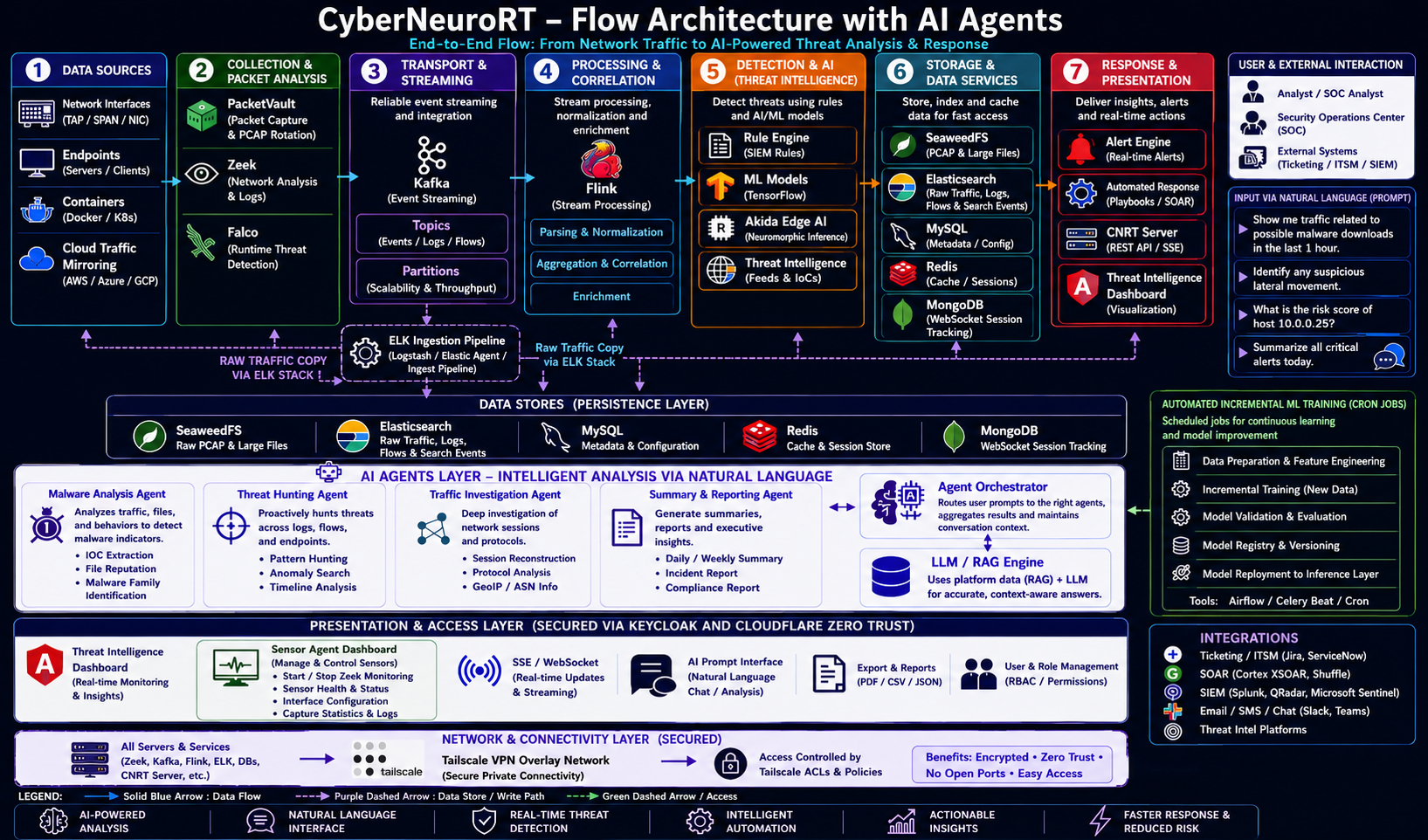
Flow Architecture
Executive Overview
Modern enterprise networks are highly distributed, cloud-connected, encrypted, and continuously evolving. Traditional signature-based detection systems struggle against:
- Zero-day attacks
- Advanced Persistent Threats (APTs)
- Living-off-the-Land (LotL) techniques
- Fileless malware
- Insider threats
- Multi-stage attack campaigns
- AI-assisted adversaries
CyberNeuroRT addresses these challenges through an AI-first architecture capable of understanding network behavior, communication intent, and temporal relationships across millions of events.
The platform continuously monitors network traffic, correlates activity across multiple protocols, applies AI-driven behavioral analytics, and provides analysts with contextual investigations rather than isolated alerts.
Why CyberNeuroRT
CyberNeuroRT was designed around one principle:
Security analysts should spend time investigating threats—not collecting evidence.
Instead of producing thousands of disconnected alerts, CyberNeuroRT automatically correlates evidence, enriches detections, and generates investigation-ready intelligence.
Key platform objectives include:
- Continuous network visibility
- AI-driven behavioral threat detection
- Real-time investigation assistance
- Reduced alert fatigue
- Automated evidence correlation
- Explainable AI-assisted decision making
- Human-in-the-loop response
- Enterprise-scale multi-tenancy
Platform Capabilities
CyberNeuroRT delivers an end-to-end cybersecurity workflow spanning detection, investigation, reporting, and response.
Real-Time Network Visibility
CyberNeuroRT continuously captures and analyzes network telemetry from enterprise environments, providing comprehensive visibility into network communications.
Supported capabilities include:
- Live network traffic monitoring
- Historical traffic exploration
- Protocol analysis
- Flow visualization
- Host communication mapping
- Session reconstruction
- Behavioral baselining
- Network asset discovery
Analysts gain immediate insight into what is occurring across the network without relying solely on endpoint telemetry.
AI-Powered Threat Detection
CyberNeuroRT combines multiple AI techniques to identify malicious activity with high confidence.
Detection engines include:
- Supervised Machine Learning
- Behavioral Analytics
- Statistical Anomaly Detection
- Rule-Based Detection
- Temporal Correlation Models
- Neuromorphic Spiking Neural Networks (SNN)
- Threat Intelligence Correlation
Rather than depending exclusively on signatures, CyberNeuroRT evaluates:
- Behavioral deviations
- Traffic relationships
- Communication timing
- Protocol characteristics
- Network context
- Historical observations
This layered approach significantly improves detection of both known and previously unseen attacks.
Threat Detection Coverage
CyberNeuroRT is designed to detect a broad spectrum of enterprise cyber threats, including but not limited to:
Malware
- Malware communications
- Backdoors
- Remote Access Trojans (RATs)
- Botnet activity
- Downloaders
- Droppers
Ransomware
Behavioral indicators including:
- Encryption-related activity
- Lateral movement
- Beaconing
- Command-and-Control communications
- Rapid file access patterns
Credential Attacks
- Brute-force attacks
- Password spraying
- Credential stuffing
- Authentication abuse
- Unauthorized account usage
Reconnaissance
- Port scanning
- Network discovery
- Service enumeration
- Host fingerprinting
- Internal reconnaissance
Web Application Attacks
Including:
- SQL Injection
- Cross-Site Scripting (XSS)
- Directory traversal
- Command injection
- Application-layer abuse
Network Attacks
- Denial-of-Service (DoS)
- Distributed Denial-of-Service (DDoS)
- Protocol abuse
- Flood attacks
- Reflection attacks
Command & Control
CyberNeuroRT identifies suspicious communication patterns such as:
- Beaconing
- Periodic callbacks
- DNS tunneling
- Encrypted C2 channels
- Domain generation algorithms (DGA)
Lateral Movement
Behavior-based identification of:
- Internal propagation
- Remote execution
- Administrative abuse
- Credential reuse
- Privilege escalation patterns
Insider Threats
Behavioral anomalies including:
- Unusual communication patterns
- Data movement
- Abnormal resource access
- Policy violations
Detection capabilities continue to evolve through controlled AI model updates, intelligence feeds, and behavioral learning.
Neuromorphic AI
One of CyberNeuroRT's distinguishing capabilities is its integration of Neuromorphic Artificial Intelligence.
The platform incorporates Spiking Neural Networks (SNNs) inspired by biological neural systems to perform ultra-low latency inference.
Benefits include:
- Millisecond-scale inference
- Energy-efficient computation
- Reduced compute overhead
- High-speed event processing
- Edge deployment readiness
Neuromorphic inference complements conventional machine learning models, enabling rapid identification of evolving attack behaviors.
AI Agents
CyberNeuroRT includes an enterprise AI Agent framework designed to assist security analysts throughout the investigation lifecycle.
Rather than functioning as a generic chatbot, AI Agents operate as specialized cybersecurity assistants capable of interacting directly with platform intelligence.
Capabilities include:
- Threat hunting
- Natural language investigations
- Network search
- IOC lookup
- Threat intelligence queries
- Investigation planning
- Guided workflows
- Evidence correlation
- Report generation
- Security recommendations
Analysts can interact using natural language such as:
Show all suspicious outbound connections.
Investigate traffic from 10.0.5.23.
Generate an executive incident report.
Correlate these indicators with threat intelligence.
AI Agents dramatically reduce investigation time while maintaining analyst control over critical decisions.
Investigation Engine
CyberNeuroRT transforms isolated detections into structured investigations.
The Investigation Engine automatically:
- Correlates related events
- Builds attack timelines
- Groups evidence
- Associates affected assets
- Maps attacker behavior
- Identifies likely attack progression
Instead of reviewing hundreds of independent alerts, analysts receive investigation-ready cases containing contextual evidence.
PacketVault Engine
CyberNeuroRT includes the PacketVault Engine, an intelligent packet capture and retrieval system designed for forensic analysis.
PacketVault enables:
- Selective packet capture
- High-speed traffic recording
- Historical packet retrieval
- Investigation-based packet access
- Long-term evidence preservation
- Capture replay for forensic analysis
Unlike traditional continuous packet recording, PacketVault optimizes storage while preserving critical evidence for investigations.
Threat Intelligence Integration
CyberNeuroRT enriches detections using integrated threat intelligence.
Supported capabilities include:
- IOC correlation
- IP reputation
- Domain reputation
- URL intelligence
- Hash reputation
- MITRE ATT&CK mapping
- Threat enrichment
Threat intelligence provides additional context that helps analysts rapidly assess the severity and credibility of detections.
Analyst Experience
CyberNeuroRT provides a unified analyst workspace designed to streamline investigations.
Key capabilities include:
- Live dashboards
- Real-time alerts
- Interactive investigations
- Traffic search
- Historical analysis
- Timeline visualization
- AI-assisted recommendations
- Context-aware evidence
The platform minimizes context switching by integrating investigation, AI assistance, reporting, and response into a single interface.
Automated Reporting
CyberNeuroRT automatically generates professional investigation reports suitable for both technical and executive audiences.
Reports may include:
- Executive Summary
- Investigation Metadata
- Network Overview
- Behavioral Findings
- Machine Learning Assessment
- Threat Intelligence Findings
- IOC Correlation
- Timeline of Events
- MITRE ATT&CK Mapping
- AI Assessment
- Analyst Conclusions
- Recommendations
Reports support collaborative editing, approval workflows, and export for compliance and incident response documentation.
Response & Containment
CyberNeuroRT supports both automated and analyst-approved response actions.
Available capabilities include:
- Traffic blocking
- Connection termination
- Host isolation
- Communication containment
- Investigation escalation
- Analyst approval workflows
Organizations can implement response policies that balance automation with operational oversight.
Enterprise Architecture
CyberNeuroRT is built using a scalable streaming architecture optimized for enterprise deployments.
Key architectural characteristics include:
- Event-driven processing
- Distributed analytics
- Streaming data pipelines
- High-throughput ingestion
- Horizontal scalability
- Multi-service architecture
- Containerized deployment
- High availability
The platform supports deployment across:
- On-premises
- Private cloud
- Public cloud
- Hybrid cloud
- Edge environments
Multi-Tenant Design
CyberNeuroRT is designed for enterprise and Managed Security Service Provider (MSSP) environments.
Features include:
- Complete tenant isolation
- Independent investigations
- Tenant-specific AI analysis
- Segregated reporting
- Secure access controls
- Scalable resource allocation
The architecture enables organizations to securely manage multiple customers or business units from a single platform.
Security Architecture
CyberNeuroRT aligns with modern enterprise security principles.
Security capabilities include:
- Zero Trust architecture support
- Role-Based Access Control (RBAC)
- Multi-factor authentication integration
- Secure API authentication
- Encrypted communications
- Audit logging
- Fine-grained authorization
- Least-privilege enforcement
Designed For
CyberNeuroRT is suitable for organizations requiring advanced network defense capabilities, including:
- Enterprise Security Operations Centers (SOC)
- Managed Security Service Providers (MSSPs)
- Government Agencies
- Defense Organizations
- Financial Institutions
- Healthcare Providers
- Critical Infrastructure Operators
- Telecommunications Providers
- Manufacturing Organizations
- Cloud Service Providers
Business Benefits
Organizations adopting CyberNeuroRT can realize significant operational improvements:
- Faster threat detection
- Reduced Mean Time to Detect (MTTD)
- Reduced Mean Time to Respond (MTTR)
- Improved analyst productivity
- Reduced alert fatigue
- Higher investigation accuracy
- Improved incident reporting
- Better operational visibility
- Scalable enterprise security operations
Getting Started
To begin using CyberNeuroRT:
- Deploy platform services and network sensors.
- Connect monitored network interfaces.
- Configure tenant environments and user access.
- Enable AI detection and investigation services.
- Integrate threat intelligence sources.
- Explore real-time dashboards and investigations.
- Configure automated response workflows.
- Review generated reports and operational insights.
Additional documentation is available for installation, configuration, API integration, troubleshooting, and platform administration.
What’s Next
If you are new to CyberNeuroRT, the recommended next steps are:
- Review the Installation guide to deploy sensors and services
- Follow the Usage section to explore detection and dashboards
- Refer to API Documentation for integrations and automation
- Use Troubleshooting for common operational questions
Conclusion
CyberNeuroRT is more than a Network Detection and Response platform.
It is an enterprise AI-powered cyber defense platform that unifies real-time monitoring, behavioral analytics, neuromorphic AI, AI-assisted investigations, PacketVault forensic capture, threat intelligence, automated reporting, and response orchestration into a single operational ecosystem.
By combining advanced artificial intelligence with human expertise, CyberNeuroRT enables organizations to detect threats earlier, investigate faster, respond with confidence, and continuously strengthen their cyber resilience.
← Back to MetaGuard AI Website